
Dallas County Arrest to Court Records
The Dallas County pathway starts with arrest and booking, then moves to magistrate review, bond, prosecutor screening, and court filing. The Dallas County jail profile may show charge text, warrant number, magistrate, and bond amount, but that is not the final court record. Formal case records may show a different charge, a reduced charge, an amended filing, a dismissal, a grand-jury action, or a final disposition. A person can be booked on one allegation and later face a different filed offense.
The main online path is the Dallas County and District Court Case Information and Documents portal. Dallas County's record-search page says public access to the courts portal does not require registration for the listed record categories, including felony and misdemeanor records. Felony records are handled by the District Clerk. Class A and B misdemeanor records are handled by the County Clerk criminal courts division.
The manifest screenshot from the Dallas County record-search page shows the official court record access point and clerk contact routing.
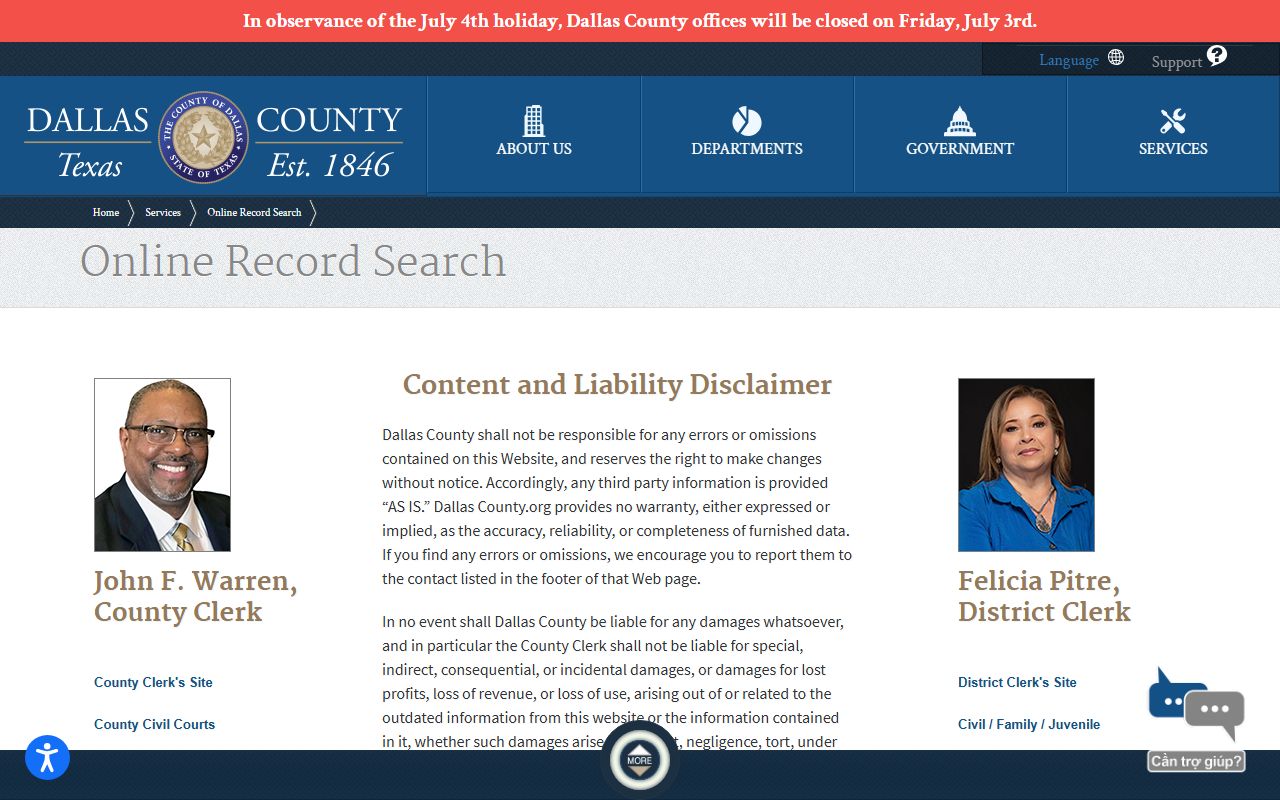
That routing matters because the jail, the court portal, the District Clerk, the County Clerk, and the DA each answer different parts of the post-arrest record trail.
Dallas County Court Search Fields
Dallas County criminal case searching can start with a defendant name, a case number, or a role-based name search. The research captured fields from the criminal background and case-search entry, including defendant, bondsman, and defense attorney options. The court portal can also be searched with warrant numbers noted on jail profiles through Smart Search. A court search is strongest when the user has the exact name, date of birth, case number, or warrant number from the jail record.
| Field Label | Type | Required | Notes |
|---|---|---|---|
| Last Name | Text | Yes | Primary name field for defendant or person search. |
| First / Middle Name | Text | Optional or unspecified | Helps narrow common names. |
| Name Type | Radio | Optional or unspecified | Defendant, Bondsman, or Defense Attorney. |
| Race / Sex | Radio or dropdown | Optional or unspecified | White, Black, Asian, Unknown; Male, Female, Unknown. |
| DOB Month / Day / Year | Dropdown and text | Optional or unspecified | Useful for separating people with the same name. |
| Number Type | Radio or dropdown | Optional or unspecified | Bonds or Cases. |
| Pending / Disposed | Radio or dropdown | Optional or unspecified | Filters active and completed cases. |
| Case Number | Text | Optional or unspecified | Direct case-number path when known. |
Dallas County Felony and Misdemeanor Records
Felony court records after a Dallas County jail arrest belong with the Dallas County District Clerk. The District Clerk is the custodian for Dallas County felony courts and the Magistrate Court in the Lew Sterrett Justice Center. The research notes state that online criminal case information dates back to 1975, and felony documents are available for most felony cases filed after 2009. The felony records desk is in the Frank Crowley Courts Building, second floor, with weekday hours from 8:00 a.m. to 4:30 p.m. The phone number is 214-653-5950, and copy requests may be made in person or by email at DCRecordsCriminal@dallascounty.org.
Class A and B misdemeanor court records belong with the Dallas County Clerk criminal courts division. The County Clerk handles 11 county criminal courts and appeals from justice or municipal courts in two criminal courts of appeals. The County Clerk criminal courts office is at the Frank Crowley Courts Building, 133 N. Riverfront Blvd., second floor, Room A-1, Dallas, TX 75207. The phone number is 214-653-7099, and the listed hours are 8:00 a.m. to 4:30 p.m. weekdays.
| Record Type | Custodian | Contact Path |
|---|---|---|
| Felony case records | Dallas County District Clerk | Criminal records desk, 214-653-5950. |
| Class A/B misdemeanor records | Dallas County Clerk | Criminal courts division, 214-653-7099. |
| Prosecutor filing status | Dallas County Criminal District Attorney | DA case-status reports. |
Dallas County Court Charging Records
Court records after a jail arrest are built around charging documents. The precise document depends on the offense level, case stage, and prosecutor action. A complaint can support early case processing. An information is a prosecutor-filed charge used in many non-indictment settings. An indictment is a grand-jury charging document, most often tied to felony prosecution. The Dallas County DA case-status page is useful because it links grand-jury cases scheduled, grand-jury dispositions by date range, felony cases accepted, and misdemeanor case filings by date range.
| Document | Who Uses It | What It Means |
|---|---|---|
| Complaint | Officer, complainant, or prosecutor path | Sworn allegation or early charging document tied to criminal processing. |
| Information | Prosecutor | Formal prosecutor-filed charge commonly used without grand-jury indictment in many cases. |
| Indictment | Grand jury | Formal grand-jury charge for felony prosecution. |
Dallas County Prosecutor Filing Path
The Dallas County Criminal District Attorney's Office is the prosecutor for county criminal cases. Its homepage links to post-arrest resources, online county record search, case and grand-jury status, discovery resources, victim services, and public-information requests. The DA, not the jail, decides whether to accept, decline, amend, reduce, dismiss, or present a felony case to a grand jury. That is why jail charges and court charges should be compared before drawing conclusions from a booking record.
The DA's office is at the Frank Crowley Courts Building, 133 N. Riverfront Blvd., LB 19, Dallas, TX 75207. The main phone number captured in the research is 214-653-3600. Victim services materials point to VINE/VINELink and 1-877-894-8463 for Victim Information and Notification Everyday. TDCJ IVSS is separate and applies to TDCJ custody or parole and mandatory supervision notification.
Dallas County Arrest Charge Status
Charge status terms describe where the case sits after the jail arrest. Pending means no final disposition has been entered. Filed means the prosecutor has put a formal case into court. Indicted means a grand jury has returned a felony charging document. Amended or reduced means the charge changed from an earlier version. Dismissed means the charge was ended without a conviction on that count. Disposed means the court record has a final outcome such as plea, conviction, acquittal, dismissal, or another closing event.
| Status | What It Means |
|---|---|
| Pending | The case or charge remains open. |
| Filed | The prosecutor has created a formal court case. |
| Indicted | A grand jury returned a felony charging document. |
| Amended or reduced | The filed charge changed from the earlier booking or case wording. |
| Dismissed | The charge ended without a conviction on that count. |
| Disposed | The court record has a final outcome. |
Note: A jail roster charge is an arrest and custody field, while a court disposition is the legal outcome of the case.
Bond Records After Arrest
Texas Code of Criminal Procedure Article 15.17 is the bridge between arrest, magistrate warnings, probable-cause review, and bail. Texas Chapter 17 governs bail. Dallas County roster profiles can show the magistrate and bond amounts, including the county note that $0.00 means no bond was permitted to be set by the magistrate. The court record may later show bond changes, conditions, revocation, or case events that do not appear in the jail profile.
| Bond Type | How It Works |
|---|---|
| Cash bond | Dallas County requires cash, cashier's check, or money order payable to Dallas County for cash bonds, with local DFW bank or financial institution rules for checks and money orders. |
| Surety bond | A licensed bail bond company posts the bond and charges a fee. |
| Personal or PR bond | Release is based on promise and court conditions rather than full cash deposit. |
| No-bond hold | Release is blocked until a court, magistrate, or holding agency changes the status. |
| Detainer | Another jurisdiction or agency hold may prevent release even when Dallas County bond appears payable. |
Warrants and Court Smart Search
Dallas County has two official warrant or wanted channels: the Sheriff's active warrant search and Dallas County Wanted search. These are separate from the jail lookup. Before an arrest, a warrant search may show an active warrant. After an arrest, the jail roster may show a warrant number in the charge table. The roster note says warrant numbers can be used in Dallas County Courts Portal Smart Search, which makes the warrant number a bridge between the jail record and court records after a jail arrest.
The Sheriff's active warrant search requires first name, last name, and date of birth. Dallas County Wanted search supports name, zip, case number, citation number, license plate or VIN, photo-only filters, warrant-only filters, race, sex, and year of birth. The warrant general information line is 214-761-9026. Municipal warrants may belong to city court or city detention channels, so a county search may not capture every local warrant.
Charges, Convictions, and Expunction
An arrest or charge is not a conviction. The public may see a booking charge, a complaint, an information, or an indictment before any court finding is made. A conviction requires a plea, verdict, or other court outcome. Texas Code of Criminal Procedure Chapter 55A governs expunction for eligible records. Dallas County research did not identify a county policy that automatically removes every online jail item after dismissal or expunction, so record-clearing questions should be handled through the court and official records channels.
| Issue | Charge | Conviction |
|---|---|---|
| Stage | Accusation or filed offense. | Final court outcome by plea, verdict, or judgment. |
| Proof | Lower early-case standard or prosecutor filing decision. | Legal finding or plea under criminal procedure. |
| Record Meaning | Shows allegation or case activity. | Shows resolved guilt or final judgment when entered. |
| Issue | Sealed | Expunged |
|---|---|---|
| Public visibility | Restricted from ordinary public view when a court order applies. | Removed or treated under Texas expunction rules when granted. |
| Legal basis | Depends on the record type and court order. | Texas Chapter 55A controls eligible arrest and criminal records. |
| Best source | Court clerk and case file. | Court order and official agency compliance route. |
Public Records After Dallas Arrest
Texas Government Code Chapter 552, the Public Information Act, is the general public-access law for government records unless an exception applies. Section 552.108 can affect law-enforcement and prosecutorial records in active matters. Public court records may be available through the portal or clerks, while records not online may need a request to the sheriff, clerk, DA, or other agency that holds the file. Juvenile records, sealed records, expunged records, and active investigation materials may be limited.
For custody details that start the court search, use the Dallas County inmate records lookup. For booking photos tied to the jail profile, use the Dallas County jail mugshots record rather than expecting the court portal to serve as a photo source.